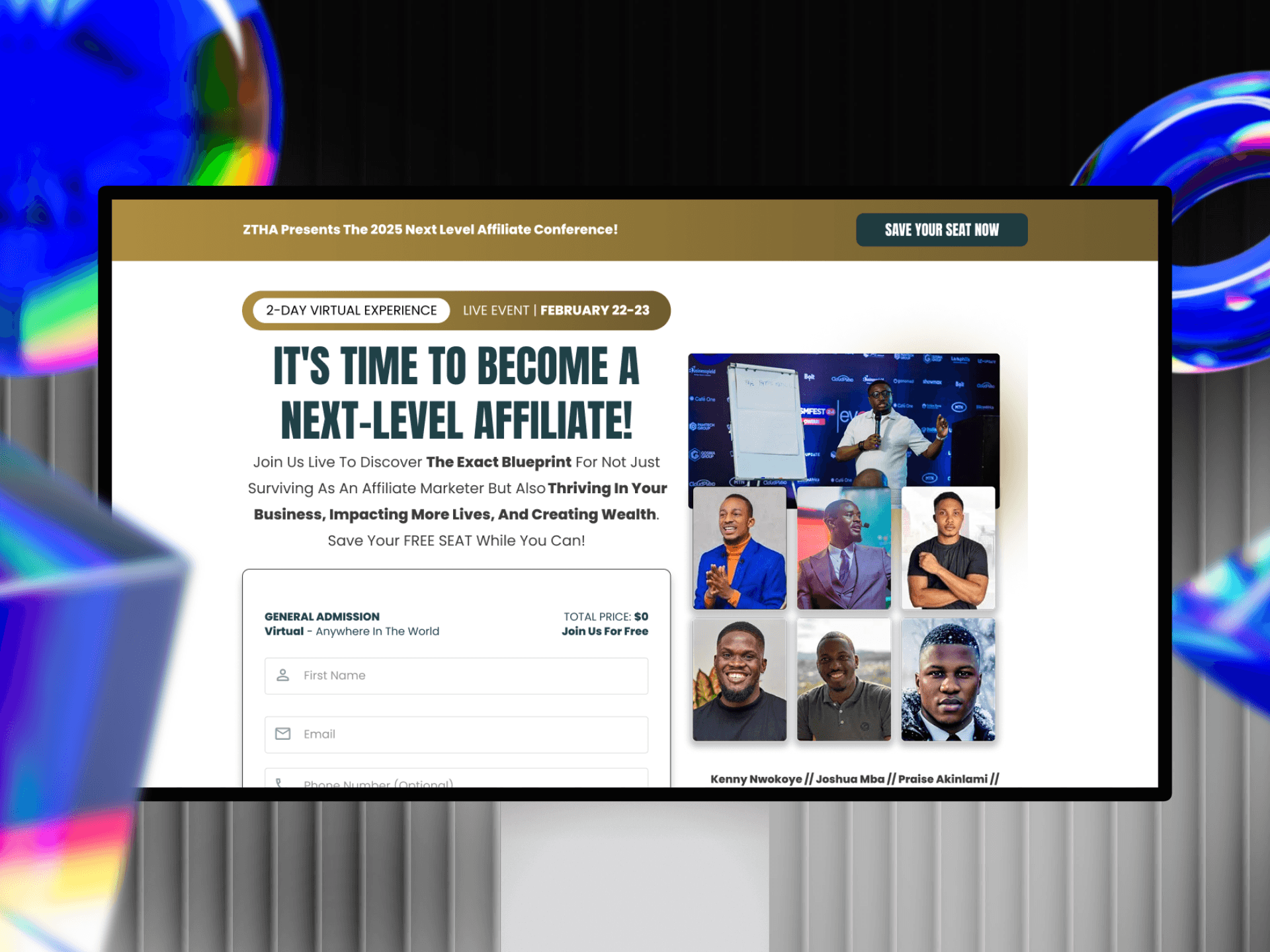
In January 2025, we started building the funnel for the Next Level Affiliate Conference, a free 2-day virtual event organised by Kenny Nwokoye, one of the most recognised names in Nigerian internet marketing. By the time the event went live on February 22nd and 23rd, over 4,000 people had registered, more than 150 had paid for a VIP upgrade, and over 40 people converted into a high-ticket academy on the backend. This is a breakdown of how that funnel worked from start to finish.
What the event was
The Next Level Affiliate Conference was a free 2-day virtual event for affiliate marketers who wanted to position themselves for the next wave of opportunity in the industry. The event featured 7 speakers, including Kenny Nwokoye, Joshua Mba from Stakecut, and Milton Tutu from Selar. Attendance was completely free. The upsell was a VIP experience priced at ₦10,000, which gave attendees access to Q&A sessions with the speakers, exclusive bonuses, and a private Zoom room during the event, while free attendees streamed on YouTube.
Why this funnel was different
Most event funnels stop at registration. You build a page, drive traffic, and hope people show up. This funnel was designed to move people through stages with intention at every point. The goal was not just to get registrations. It was to maximise the number of people who upgraded to VIP before the event, show up on both days, and convert into the backend offer after it ended.
How the funnel worked
Traffic came from two sources. Paid Facebook ads drove cold traffic to the registration page. Kenny also leveraged his existing audience of over 250,000 people across WhatsApp, email, and social media. The combination of paid and organic meant the funnel was being fed from multiple directions at the same time.
When someone landed on the registration page, they got the full picture of what the event was about, who was speaking, and what they would walk away with. The page was built to do one job which was to get them to register. After registration, the funnel splits into two paths.
Those who registered were immediately presented with an upsell for the VIP experience. Anyone who took it was sent to a checkout page to pay and then to a VIP thank you page. Anyone who did not upgrade was sent to a standard confirmation page, which also had an option to upgrade to VIP if they changed their mind. Both confirmation pages included a link to join the private Telegram community for attendees, so everyone felt like they were part of something before the event even started.
After registration, a follow-up system ran in the background for everyone who had not yet upgraded to VIP. The goal was to nurture them, remind them of what they would get with the upgrade, and give them reasons to take action before the event started. At the same time, VIP members were receiving early access to some of their bonuses before the event, which kept them engaged, reminded them of the value they had paid for, and reduced buyer's remorse.
When the event went live on February 22nd, the two audiences had different experiences by design. Free attendees watched on YouTube. VIP members had a private Zoom link and got access to the Q&A sessions with the speakers. At the end of each day, the YouTube stream ended for free attendees while the VIP Q&A session continued on Zoom. This made the upgrade feel real and valuable rather than just a name on a ticket.
On day 2, when the conference closed and the backend offer was presented, anyone who indicated interest was added to a WhatsApp group. Rather than sending them to a sales page and hoping they would convert on their own, the backend was handled as a personal conversation. The group was used to present the offer, answer questions, follow up with people who needed more time, and open up slots for the academy that was being launched. Because the group was made up of people who had already indicated they were interested, the conversations were warmer, and the close rate was higher than it would have been through a standard funnel page alone.
The results
4,000 plus registrations for a free 2-day event. Over 150 paid VIP upgrades at 10,000 Naira each. More than 40 people converted into the backend academy after the conference ended.
What made this work
A few things stand out when I look back at this funnel. The first is that every stage had a job and knew what it was supposed to do. The registration page got registrations. The upsell page sold the upgrade. The follow-up sequence kept people warm. The confirmation page gave people a way to upgrade if they changed their mind. Nothing was just decoration.
The second thing is that the event itself was designed around the funnel. Free attendees and VIP members had different experiences on purpose. That difference made the upgrade feel real, which is why people paid for it.
The third thing is the backend. Most people think the conference is the event. In this case, the conference was the top of the funnel. The real offer came after it ended, and the WhatsApp group approach made it feel personal rather than like a sales push to a list.
If you are planning an online event and you want to build a funnel that actually performs, the key is to think beyond the registration page. Every touchpoint from the first ad to the post-event follow-up is part of the system, and each one has a job to do.
Follow me to keep in touch
Where I share my growth journey, funnel strategies, and industry thoughts.